
In this interview, Paula Guastavino speaks with Fabrizio Nastri, founder and CEO of FlexUp, at Station F in Paris. If you have crossed paths with FlexUp, you probably know what it is, what it does and how it works.
Paula wanted to learn about the "origin story" underneath. Fabrizio traces the path from a career in large international organizations, through the everyday friction of building companies, to a hopeful conclusion: most business conflict is not caused by difficult people, but by the systems that influence their behaviors. Some systems create structural friction. Fabrizio's vision is that designing more virtuous systems can reduce conflict and encourage collaboration.
FlexUp is the result of eight years of thinking, designing, and building a new economic model that aligns financial interests and encourages collaboration between all stakeholders in a business. In the process, it also brings a fully integrated platform, with a business management app, a standardized legal framework and an ecosystem of partners ready to help you start, structure and grow your business. The interview is a deep dive into the philosophy, design, and practical implementation of FlexUp.
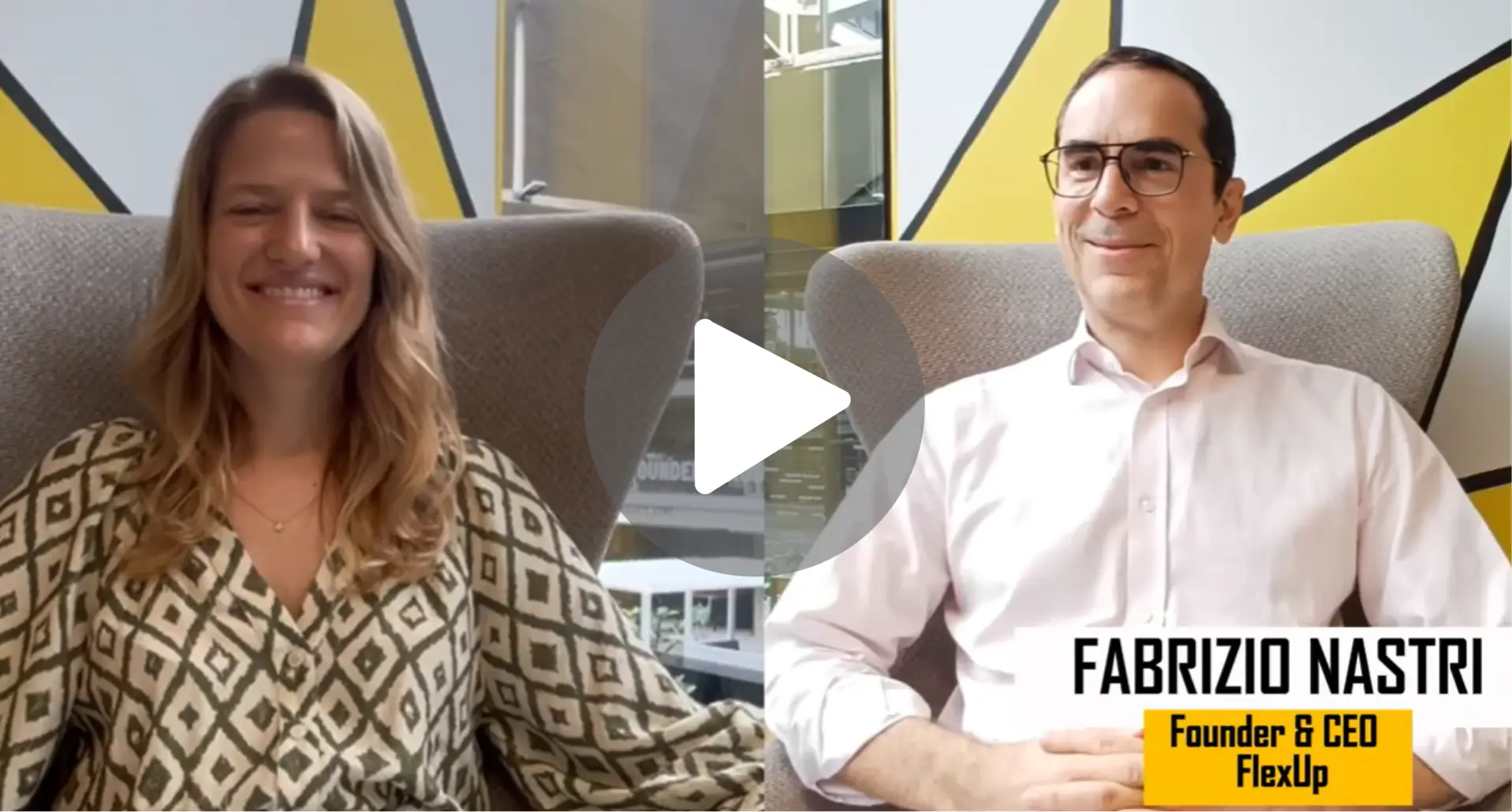
Paula Guastavino talks to Fabrizio Nastri, founder and CEO of FlexUp, at Station F in Paris.
Watch the full interview or read it below.
The Interview
Paula: Before FlexUp existed, what kind of situations where you personally facing?
Fabrizio: That is a big question. When I started my career, I went straight into large international organizations – Shell, Boston Consulting Group, ArcelorMittal. And there I could see that different people in the organization had very different incentives, which created distortions and internal conflicts.
A plant manager is measured on how many tonnes of steel are produced. A business unit manager has a bonus based on the profitability of the unit, the EBITDA. Senior management looks at the share price and the dividends. And teams closer to the ground look at their own performance, or their team's. So there is a great disconnect in the incentives of different people within an organization. That was the first thing I noticed in corporate life.
Then I became an entrepreneur, many times over. The first thing you notice is the complexity of starting a business. You get an avalanche of administrative things you have never heard of, it takes a lot of your time, and you keep realizing that you were supposed to do something you have not done – so there may be a fine, or an extra procedure to fix what you did not know you had to do.
When I created subsidiaries in Africa, I set one up and sent money to fund it. Six months later someone showed up and told me that I should have filed a declaration with an agency I did not know existed – a requirement with no equivalent in France, so it had never occurred to me to look for it. And because I had not done it, there were going to be lots of penalties.
Paula: So your expertise is in the business you are working on, but not in how to administer, structure, and run a company.
Fabrizio: Exactly. When you start a business you need to be an expert both in your specific field and in how to manage a company, and the second part has no value added. It just takes a huge amount of time.
And there is a third thing I found hard as an entrepreneur: you really feel that you are alone and fighting with everybody else. You need to pay your employees. You need to pay your suppliers. You need your clients to pay you. You need to convince investors to put money into your company – and once they have, they expect you to generate profits and pay dividends. But they are not really helping you on a day-to-day basis. They are just breathing down your neck, asking why you are not delivering on the expected projections.
So there is pressure on all sides, and you feel that nobody is on your side.
Paula: So everyone is looking after themselves, and the interests are not aligned.
Fabrizio: That is the issue. You can have great team spirit, and everybody can be nice. But when difficulties arrive, people can suddenly turn their coats around.
In one of my first companies, I had promoted a close colleague to Deputy General Manager. I gave her a big bonus and pay rise. That gave her an official mandate as a director of the company – and under French law, a director who loses their job no longer qualifies for unemployment support. So when we had to restructure and put together a voluntary severance package, there was a form to complete with a tick box: is this person a director? The honest answer was yes. Ticking it meant she would not get unemployment benefits. Not ticking it meant that I would have to pay a huge amount of additional social contributions, because of the big bonus I had just given her.
She told me that if I ticked that box, she would “pull out the war axe” – and she said it really violently. That was not honest, towards the state, and not fair, towards me. A person who was still, a few seconds before discovering this checkbox, a friendly and trustworthy colleague and associate (I had also given her lots of shares) suddenly became an enemy. Does that make her a bad person? I would not say that. Is that the result of a poorly designed system? Certainly yes. And it’s a great illustration of the influence that systems have over people, and their willingness to collaborate. It shows the power that a checkbox can have over people.
Paula: A good person, a great relationship – but once the financial interests are no longer aligned, you find yourselves on opposite sides.
Fabrizio: Precisely.
Paula: You faced many different situations, but was there one in particular that was the deal breaker – the turning point where you said, okay, there has to be another way of doing business?
Fabrizio: Yes, when my second startup, Canopy, went bankrupt. I had been running that company for eight years. I co-founded it with a friend who, after a few years, decided to leave – the business was not growing as quickly as he had hoped, and he had other opportunities. So he walked away, and he immediately sued me, asking me to buy out his shares.
And he did that at a moment when the company was close to bankruptcy and I was putting 800 000 € of fresh cash in to keep it alive. It was basically worth 0, but to avoid diluting the other shareholders (primarily friends, family and employees), I did the funding round at a 2 € million pre-money valuation - which was extremely generous. Crazy. Of course, he expected me to buy his shares at that valuation, which would have meant dishing out another 800 000 €, which I did not have of course. This was completely unreasonable.
Then I ran the company alone for another four years. We expanded into Africa and opened five subsidiaries and worked in ten countries. The business environment there is very promising – if you do things well, you can make a lot of money in Africa, because the demand is there, and sometimes there is not a lot of competition. But as soon as you start making a lot of money, there there’s a lot of problems that pop up. In our case, one of the governments did not pay us for a large contract we had started to work on, and that pushed the company to bankruptcy.
And then I said, okay, I have been running this company for eight years, I am going t take a sabbatical, sit down, and think about how we can do this differently. That was the real moment. When Canopy went bankrupt, I thought: there has to be another way. It is just crazy that the whole world of business goes through all this complexity and all this conflict that turns people against each other, when there is no reason for it.
Paula: So you saw that it was not the surface. It was the system underneath, the whole structure you were living through.
Fabrizio: Yes. The first company I created was called CoSys – Collaborative System Design. My initial intuition was that the current economic system is the result of centuries of evolution in how to do business. Centuries, even millennia, if you go back to prehistory when people were bartering. And a lot of those changes either happened by accident or happened progressively. There are not many times in history where people sat down and said: okay, let us just design the system.
We have objectives. We have specifications for what we want the system to do, and based on those objectives we are going to design it. We are going to design a system that encourages people to collaborate – that is why I call it Collaborative System Design. And we are going to design this system in a collaborative way. So it can be understood in two ways: the end product is collaboration, but the process is also collaboration.
So I said, let us try to apply this methodology to redesign the economic system.
Paula: And what were the objectives?
Fabrizio: When businesses and people work together on something with an economic element – it does not need to be a registered company, any kind of project with some economic activity – I want them to generate more wealth, and I want to make sure that this wealth is distributed more fairly. Because poverty and income inequality are two main sources of conflict and instability. We see this in poor countries and in developed countries, where people are super rich but there are still poor people, and that creates frustration, instability, populism, and so on.
Now, how do we achieve this? My gut feeling is that collaboration is better than conflict. If people collaborate more, they will generate more wealth. And if they know that this wealth is going to be shared, that is an additional incentive to collaborate.
So how do you get people to collaborate? One of the mechanisms – not the only one – is to align their financial interests. There are other ways: you can have a great company culture with free snacks and nice music and a lounge where people relax. There are many ways to create a nice environment. But one very important one is the alignment of financial interests. There is a lot of literature saying incentives matter, people respond to incentives.
It is a big part, and it is a part that people often do not see, especially when there is a conflict. Oh, we have a conflict, that means you are a bad person, I do not like you. But no. What is going on is that we have opposed financial interests, and therefore what you are doing does not suit me, and vice versa. Most people judge other people, but they do not analyze the system that motivates those people.
So, one of the guiding philosophies of Collaborative System Design is: do not judge the people, analyze the system, and try to understand the underlying mechanisms that drive behaviors.
Paula: So how do you align financial interests when you have investors, founders, employees, suppliers, and clients?
Fabrizio: In the current system, each of these groups has a standard way of doing business. If I am an investor, I put money in the company, I get shares, and then I get dividends. If I am an employee, I have a salary, I have a pay slip every month, maybe a bonus based on my performance or the company's performance. All of these different stakeholder groups have different types of deals, different ways of being paid, and different remuneration systems.
So my intuition was: if I want to align financial interests, I am going to put everybody on the same remuneration system. And that introduces the principle of non-discrimination. There is no difference between a founder, an employee, a supplier, a client, an investor – and tomorrow a bank, or a state, if they want to play along. They will probably be the last ones to join the bandwagon, but hopefully at some stage we can have a single remuneration system that is the same for every stakeholder.
And so, if the company is making a profit, everybody wins. If the company is going through a difficult period, everybody shares the pain, the effort.
Paula: How does that work in practice?
Fabrizio: You have a flexible cost structure. Some of the costs are fixed. Some of the costs are what we call Flex, and they depend on how much cash is available at the end of the month. If the company has enough cash to pay the Flex after it has paid the Firm, then everybody gets a bit of Flex – share²holders, employees, founders, everybody gets it at the same time and at the same rate. And then the rest we call Credit, it is invested in the company, and repaid when the business starts making profits
So, we create this kind of remuneration system. Say I want to hire an employee. He is a really good employee and I am going to pay him 1 000 € a month, or 10 000 €, depending which country you are in and what type of job he is doing. Let’s say I want to pay him 1 000 € a month, but I do not have enough cash to pay him fully. So, I will pay him 50% cash, 30% Flex, and 20% in Credit. That means he is investing 200 € a month in the business. When we make a profit, and we are able to pay the Firm and the Flex, then at the end of the year we also pay the Credit he has been investing over several years. In addition, he also gets a piece of the profits based on how much risk.
So it is the same system for employees, supplier, and investors. Everybody can use exactly the same mechanism. Even the clients can use the same system: they pay a bit extra, to fund the company, and in exchange their gets some credits.
Paula: And they all depend on the same factor – the payment will depend on how well the company is doing, not on pay slips or dividends at the end of the financial year.
Fabrizio: That is right. There are two elements in your question. On the one hand, how much people are going to be paid is based on one indicator, which is the availability of cash. I need to have enough cash to pay my Firm commitments, then I pay my Flex commitments, and then I can repay the Credits and distribute the extra cash.
We only look at cash. We do not look at accounting profits, because that can be played around with, and we do not look at operational metrics, because every company has a different set of KPIs. You can of course link bonuses to operational KPIs – client satisfaction, how many tonnes you produce – and that can also go into the remuneration system.
In a traditional contract, you have an agreement on what you are going to do and how much I will pay you. In the FlexUp system, you add a third question: how do I pay you? How do you split that payment between Firm, Flex, and Credit?
The payment of the Flex and the Credit is based on the same indicator for all types of stakeholders. But then, depending on what type of stakeholder you are, that payment can either be a bonus on your pay slip if you are an employee, or a dividend if you are a shareholder, or an additional compensation if you are a supplier. So the technical implementation will be different for every type of stakeholder, and it can be very different in different countries with different tax implications.
But that is what we call the technical implementation. The FlexUp model is a more abstract layer above it, which is: how do we split the cake? That’s what matters from a business point of view. How we serve then it depends on the specific situation. Is this takeaway? Then we put in a cake box. Are you eating here? Then we serve it on the plate.
Paula: So FlexUp is a system that came to shake the current system.
Fabrizio: I would not say that we want to shake the system. We are not operating against the system. We are not trying to break it. In fact, I am not criticising the current system – it is working. It is generating a tremendous amount of wealth. It is bringing millions and billions of people out of poverty. But like anything, we can always improve.
Any software has an update every few months where you have an upgrade and additional features. Sometimes you have a major upgrade, and sometimes a competing product comes out of nowhere and people say, oh, this is actually nice, I am going to switch to this other software. That is how I think about the classic economic system that we all operate in, and the FlexUp economic system.
Paula: So how do people respond?
Fabrizio: First of all, they need more than 30 seconds to understand, because we are really very innovative in many ways. We have talked about the economic model, but we are also innovating a lot in the legal framework – how we structure operations. We are developing a very powerful business app, an ERP that lets you manage all of your business: your contracts, your orders, the equity table, cash distribution, all of it from your mobile phone with a simple app. And then we have this ecosystem of partners that can help you, advise you, structure and develop your business. So, we have what I call the four core pillars: the economic model, the legal framework, the business app, and the ecosystem.
So, it takes more than 30 seconds to explain what FlexUp is. And when people really take the time to understand, generally they are very amazed. They go, wow, this is great, this is so innovative, this is so obviously positive and beneficial. So, the response is generally very positive.
When I started to talk about FlexUp a few years ago, they would think I was crazy. This is utopia, the guy is dreaming. But now that we have actually built the platform, we have users, the app is working, and the legal framework is covering a lot of ground, people understand this is very powerful, very disruptive, very innovative.
But of course, the question is: how can I use it, and is this the right time for me? Am I now starting a business, and therefore do I have specific pain points that FlexUp really solves? Then, okay, I am going to give you all my attention, you are going to explain to me how FlexUp works. I need to understand the details, because this is a big decision. I am going to structure my company using the FlexUp system instead of the classic system. This is a big commitment.
So, before I make this big commitment, I need to understand. It takes a few hours to really understand, and a few weeks to think about it, sleep over it, and say, okay, I am going to do it. That is the first challenge: you need to find people at the right time in their development journey and then spend a lot of time explaining how it is going to work in practice.
It is like when I want to build a house. I am going to spend a lot of time with my architect, and he is going to show me where the rooms are going to be. And only when I have the full plan do I say, okay, let us go do it. It is a little bit the same.
Paula: So FlexUp is a bit like an architect – you are going to show me a different way of designing and building my house.
Fabrizio: Yes, I would put it like that.
Paula: Was there ever a moment where you seriously considered that you might be wrong?
Fabrizio: Oh no. I was absolutely always convinced that I was onto something big. I knew what my destination was, and that it was just a matter of finding the right path to it and doing the climb. But the guiding objective is always the same: how to simplify business, and how to encourage collaboration.
People respond to incentives. We respond to the environment. If you put me in an environment where it is natural for me to do something, then I will do it. Why do people wear seat belts? Because every car has a seat belt, and if you do not put your seat belt on the policeman will fine you. If there were no seat belt in the car and no obligation to put it on, people would not use one.
So, it is not about changing the people. It is about creating the context where people will put their seat belt on. You just need to understand what the needs are, what the problems are, and then design a solution that meets those needs and fixes those problems. It is really a design challenge. It is a bit like somebody trying to build a product: you understand the problems that consumers face, and you design the product that will respond to their need.
And that is why I always come back to Collaborative System Design. FlexUp is the product that I have been thinking about and designing for more than eight years now. We actually started really building the app and onboarding the first users about two years ago. So, it is a lot of time designing, and now we are building, we are deploying, and it is time for us to scale.
Paula: Is there something you have never been asked about FlexUp that you think matters?
Fabrizio: There are so many things in FlexUp that I could go on forever, and nobody has asked me all the questions. So, there are always things I have not mentioned yet.
One of the principles is that part of your profit is supposed to go back to the community. You should allocate 5 or 10% of the excess cash at the end of the year to philanthropic activities, whether it is environmental impact, social impact, or societal impact – because societal issues are important to provide stability. Those are the three targets we encourage companies to give back to.
That is part of the DNA. Business is not about making profits for the shareholders and for the business owner. Business is about making the world a better place. Everybody should benefit. All the stakeholders that are part of the project should benefit – founders, employees, suppliers, clients, investors. So, the company should serve all of its stakeholders but should also serve and act for the greater society: the environment, poor people, whatever it may be.
Paula: Doing business with purpose. And who is FlexUp for?
Fabrizio: FlexUp can be used for any business at any stage. Even if you have not incorporated a company yet, or if this is just an informal project you are doing with some friends. FlexUp is very flexible, so you can apply it just to a small aspect of your business, or to the whole business.
It is free to start using it, and as you grow there is of course a subscription fee, but it is very affordable. We are there to help you and advise you – and if you cannot pay us, then you can pay us in Credit and we become your associate.
So, there is no reason not to use FlexUp. The only thing you need to do is spend a bit of time trying to understand what it is. And hopefully, once you take the time to understand what FlexUp is, you will see the benefits.
Paula: Let's not fear success.
Fabrizio: Yes, exactly. We are here to help you.
Paula: Fabrizio, thank you very much for this conversation. I wanted to know more about what is underneath FlexUp, and we both welcome everyone to look into it and take a go.
Fabrizio: Thank you so much. Thank you, Paula.
Ready to Design Your Own System?
1. Talk to Us About Your Project
The fastest way to find out whether FlexUp fits your situation is a conversation. We will look at where you are, what is misaligned, and whether the model helps.
2. Launch or Grow Your Own Project with FlexUp
Spend the few hours Fabrizio talks about and see how the model works in practice – the economic model, the legal framework, the business app, and the ecosystem.
🚀 Join our boost Program: Early access to FlexUp with free advisory support.
📅 Join a Workshop: Online and in person at Station F, Paris.
✉️ Sign up to our newsletter for updates
3. Dive Deeper with More FlexUp Stories
- Interview: From Cash-Strapped to Community-Backed: How True Local Heroes Raised Funds with FlexUp
- Interview: Reinventing Solar Project Financing in Africa
- Case Study: Rebecca Web Agency - Bootstrapping a New Business With a Team
- Insights: Why Do We Need a New Economic Model?
Don't judge the people, analyse the system: the story underneath FlexUp